Today we’re exploring a question that has haunted countless caring, conscientious people:
“Why do you stay?”
It’s a question my clients hear from friends, family, therapists—and eventually, from themselves.
But after decades of listening to these stories, I’ve come to believe they’re asking the wrong question.
Let’s begin.
There is a question almost every one of my clients has heard.
Friends ask it.
Family members ask it.
Sometimes even therapists ask it.
“Why do you stay?”
If the relationship is so painful…
If you feel so alone…
If your health is deteriorating…
If your finances are a mess…
If you’re exhausted beyond words…
Why do you stay?
At first glance, it seems like a reasonable question.
But after nearly forty years of working with NeuroDivergent couples and families, I have come to believe it is often the wrong question.
Because underneath that question lies another one.
One that is much more painful.
“What is wrong with me?”
Maybe I’m weak.
Maybe I’m broken.
Maybe I’m too dependent.
Maybe I’m not worthy of anything better.
Maybe a stronger person would have left years ago.
I hear these thoughts over and over again.
And every time I do, I want to stop the conversation.
Because I don’t believe those conclusions are true.
I don’t believe people stay because they are weak.
I think they stay because they are human.
Years ago, I began noticing something about the people who came to see me.
They weren’t selfish people.
They weren’t careless people.
They weren’t people who didn’t try.
In fact, they had often tried harder than anyone else.
They loved deeply.
They took their commitments seriously.
They believed relationships could heal.
They searched for answers.
They read books.
They went to counseling.
They prayed.
They adapted.
They forgave.
They hoped.
Again and again.
Many of them had spent years trying to understand the person they loved.
If they could just understand autism better…
If they could communicate differently…
If they could stop upsetting their partner…
If they could become calmer…
If they could find the right therapist…
Then maybe everything would finally make sense.
They weren’t simply staying.
They were searching.
Searching for an explanation.
Searching for a breakthrough.
Searching for the day when all the confusing pieces would finally fit together.
But sometimes…
They never do.
By the time many people arrive in my office, they don’t simply look tired.
They look like survivors.
Their bodies have absorbed years of chronic stress.
Some struggle with autoimmune disorders.
Some develop heart disease.
Others live with anxiety, depression, or what we now recognize as Complex PTSD.
Many have spent so many years managing everyone else’s emotional world that they no longer know how to care for themselves.
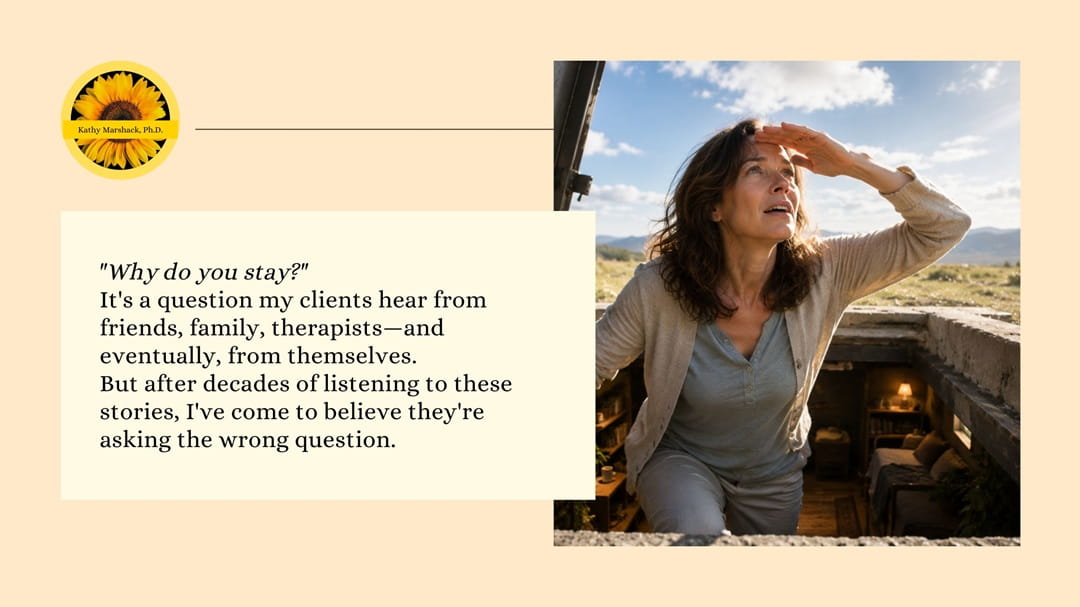
Sometimes, after clients have begun recovering, I gently tease them. I tell them they remind me of someone who has been living in an underground bunker for twenty-five years and has finally climbed into the daylight.
If you’ve seen the picture that accompanies today’s podcast, you know the one I’m talking about. At first glance, the bunker doesn’t look so bad. There are books. A comfortable bed. A lamp. Even a few plants. It almost looks…homey.
That’s the illusion.
Most people don’t wake up one morning and decide to live underground. They arrive there one accommodation at a time. One disappointment at a time. One crisis at a time. One compromise at a time.
Over the years they become remarkably good at surviving. They learn to anticipate another person’s moods. They avoid conflict. They lower their expectations. They tell themselves, “This is just how relationships are.”
Eventually, the bunker feels normal.
Then one day they climb the ladder.
The sunlight almost hurts their eyes. Not because the world has changed—but because they suddenly realize they have been living underground.
The tragedy isn’t simply that they stayed.
The tragedy is that they slowly forgot there was another way to live.
So perhaps the question isn’t…
Why do you stay?
Perhaps the better question is…
What are you protecting?
Think about that for a moment.
What have you been protecting?
Your children?
Your marriage?
Your vows?
Your family?
Your finances?
Your faith?
Your hope?
The person you once fell in love with?
The dream you believed the two of you would build together?
Those are not signs of weakness.
Those are signs of love.
But somewhere along the way, many caring people forget that there is one life they have stopped protecting.
Their own.
Perhaps now it is time to extend that same kindness toward yourself.
Not with bitterness.
Not with revenge.
Not even with certainty about whether you will stay or leave.
But with honesty.
Add:
Like the woman climbing out of the bunker, you don’t have to know exactly where you’re going next. You only have to recognize that surviving is not the same as living. Sometimes the bravest step is simply allowing your eyes to adjust to the light.
One of the hardest truths I have learned is this.
Some relationships cannot be rescued by understanding alone.
You may eventually understand the pattern.
You may recognize the different neurological operating systems.
You may finally see why the same painful cycle repeats itself.
Understanding is valuable.
But understanding does not always create change.
Sometimes it simply helps you stop blaming yourself.
That is an enormous step.
Because when you stop blaming yourself, you become free to ask a different question.
Not…
“How do I save this relationship?”
But…
“How do I save my own life?”
Radiant Empathy is not about becoming less compassionate.
It is about allowing your compassion to include yourself.
For years you may have poured your energy into protecting everyone else.
Perhaps now it is time to extend that same kindness toward yourself.
Not with bitterness.
Not with revenge.
Not even with certainty about whether you will stay or leave.
But with honesty.
Your compass cannot guide you if you refuse to listen to it.
So today I want to leave you with two questions.
The first is the one everyone asks.
Why do you stay?
The second is the one I hope you will carry with you long after this podcast ends.
What have you been protecting?
And perhaps…
Is it finally time to protect yourself with the same courage, devotion, and compassion you have spent so many years giving to everyone else?
Because this could happen to anyone.
Not because we are weak.
But because we are human.
And when we finally stop judging ourselves, we are free to become something else.
Not fragile.
Not broken.
Sadder, perhaps.
Wiser.
Stronger.
And finally…
Free to become ourselves again.
Final Thoughts
Thank you for joining me today.
If this episode touched something deep within you, I hope you’ll remember one simple truth:
You are not weak because you’ve struggled to understand a difficult relationship.
You are human.
And perhaps today you’ve discovered a gentler question to ask yourself:
What have I been protecting?
As you continue your journey, remember that Radiant Empathy isn’t about abandoning compassion for others. It’s about extending that same compassion to yourself.
If you’d like to continue this conversation, I warmly invite you to join me at the Podcast After Party inside the Compass Circle, our private community in the Radiant Empathy Universe.
The After Party is where we slow down after each episode to reflect together. Members share their own experiences, ask questions, and encourage one another as they learn to trust their inner compass. It’s a place where understanding becomes connection, and connection becomes courage.
You’ll also discover additional resources, live webinars, special events, and a welcoming community of travelers who are learning to navigate NeuroDivergent relationships with wisdom and hope.
You’ll find the links in the show notes.
Until next time, take good care of yourself.
Be brave.
Be compassionate.
And remember…
Your compass never lies.