Why High-Functioning Autism Is So Hard to Recognize—and Why Being Seen Matters
“If you can’t see it, does it exist?”
After more than thirty years of working with autistic adults, couples, and families, I still hear the same comments:
“Aren’t we all on the spectrum?”
“Oh, you think everyone is autistic.”
“I think I’m on the spectrum too, but I don’t have any problems.”
“My husband is probably a little autistic.”
“Aren’t all men like that?”
Depending on the day, these comments leave me feeling annoyed, hurt, dismissed, invalidated, and sometimes profoundly alone.
Not because people are trying to be cruel.
Most aren’t.
They simply cannot see what I see.
The Problem with High-Functioning Autism
When most people think of autism, they imagine a child who struggles with language, social interaction, or daily functioning. They picture obvious signs.
High-functioning autism doesn’t fit that picture.
The autistic adult may be highly educated. They may be successful in business. They may have a family, a career, and a mortgage. They may appear charming, intelligent, and articulate.
In fact, they may seem more competent than everyone else in the room.
Because the challenges are not obvious, observers assume they do not exist.
Yet the spouses, children, coworkers, and friends living closest to that person often experience a very different reality.
Looking at the Wrong Evidence
Most people judge relationships from the outside.
They see the autistic husband who faithfully goes to work every day.
They see the autistic wife who is devoted to her hobbies and interests.
They see a parent who never misses a soccer game.
What they don’t see is what happens behind closed doors.
They don’t see conversations that never quite connect.
They don’t see a spouse who feels emotionally invisible.
They don’t see misunderstandings that repeat for decades despite everyone’s best efforts.
They don’t see children who learn to suppress their own needs because one parent’s needs dominate the household.
The public sees behavior.
The family experiences impact.
Those are not always the same thing.
We All Have Traits
One reason autism can be difficult to recognize is that everyone shares some autistic-like traits.
Most of us have routines.
Most of us get overwhelmed.
Most of us miss social cues occasionally.
Most of us have special interests.
But having a trait is not the same as having a neurological operating system organized around those traits.
We all cough sometimes.
That doesn’t mean we all have pneumonia.
We all forget things.
That doesn’t mean we all have dementia.
Likewise, occasionally preferring solitude or liking routines does not automatically place someone on the autism spectrum.
The question is not whether a trait exists.
The question is how the traits combine into a pattern that shapes a person’s experience of the world and their relationships with others.
The Fish Doesn’t See the Water
Another reason autism is difficult to recognize is that it often exists within a system.
Family members adapt.
Spouses compensate.
Children accommodate.
Friends make excuses.
Coworkers work around problems.
Over time, everyone adjusts.
The system becomes normal.
A fish does not notice water because it has never experienced anything else.
Many NeuroDivergent families operate the same way.
The patterns become invisible to the people living inside them.
When someone finally points out the pattern, the reaction is often disbelief.
“That’s just how he is.”
“That’s just how our family works.”
“Everybody does that.”
No. Everybody doesn’t.
But if it is all you’ve ever known, it can certainly feel that way.
The Cost of Not Seeing
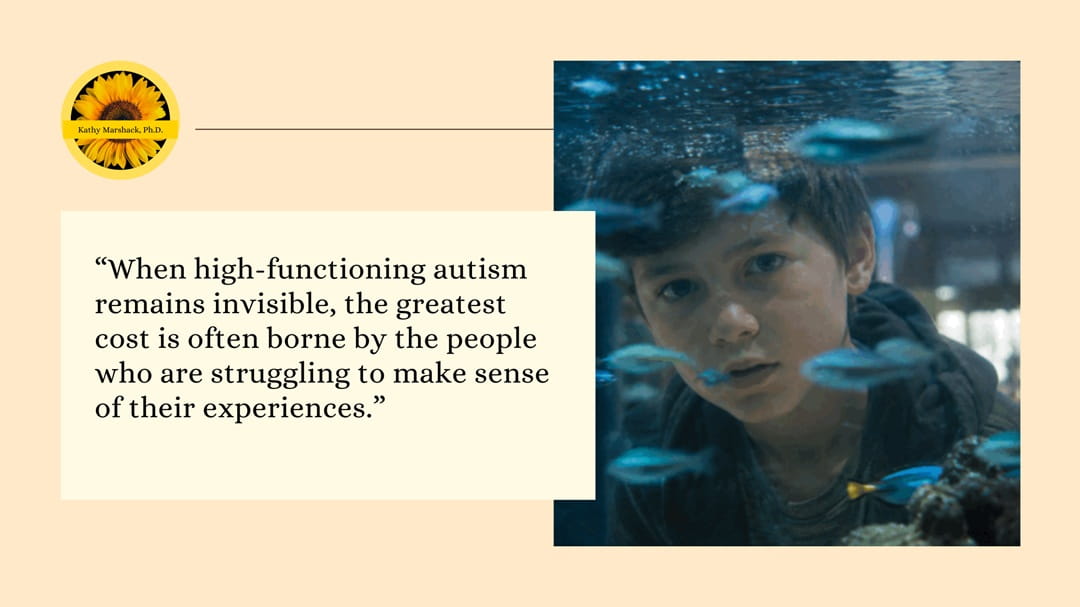
When high-functioning autism remains invisible, the greatest cost is often borne by the people who are struggling to make sense of their experiences.
I have worked with countless spouses who spent years believing they were too sensitive.
Too demanding.
Too emotional.
Too needy.
Too critical.
Then they discovered there was another explanation.
Not an excuse.
An explanation.
Suddenly decades of confusion began to make sense.
Yet when they share this realization with friends or relatives, they are often met with skepticism.
“He seems fine to me.”
“She doesn’t look autistic.”
“Maybe you’re overthinking it.”
Those responses can be deeply painful.
Not because they disagree.
But because they erase lived experience.
Seeing What Is Hidden
Recognizing high-functioning autism is not about putting labels on people.
It is about understanding patterns.
It is about understanding why two people can love each other deeply and still repeatedly miss each other’s emotional signals.
It is about understanding why good intentions do not always produce good outcomes.
It is about understanding why some families feel as though they are speaking different languages despite sharing the same home.
Most importantly, it is about replacing blame with understanding.
When we can see the pattern, we can respond to it more effectively.
When we cannot see it, we often end up blaming ourselves—or each other.
Once people begin understanding these patterns, something interesting happens. They start seeing what was previously invisible.
The Moment It Becomes Visible
One of the most fascinating things I have observed over the years is what happens after people begin to understand neurodiversity.
At first, they struggle to see it.
Then suddenly they see it everywhere.
A client once laughed and told me, “I never realized one of my coworkers was autistic. Then one day I saw it. Plain as day. Now I can’t unsee it.”
Another was a nine-year-old boy who had recently learned about his own diagnosis. He arrived at our next session bursting with excitement.
“There is another kid in my class who’s autistic too!”
He wasn’t making fun of the other child. He wasn’t labeling him. He was delighted.
For the first time, he realized he wasn’t the only one.
That is something many people misunderstand about autism. Recognition is not always about identifying a problem. Often it is about discovering that there are others who experience the world as you do.
I was reminded of this recently when a reader named Eric wrote to me after reading one of my blogs. He quoted a passage back to me:
“We move in patterns. We see connections. We anticipate outcomes. We notice what is missing. And once you see this way… you cannot unsee it.”
What struck me was not the quote itself. It was the relief behind it.
Eric had recognized himself in those words.
Not because he was searching for a label.
Because he had finally found language for experiences that had always been there.
He wasn’t telling me I had taught him something new. He was telling me I had given him language for something he had experienced his entire life.
I have seen this same relief many times.
One autistic client became devoted to therapy after our very first session. He told me I was the only therapist who had ever truly “seen” him.
Not fixed him.
Not judged him.
Not explained him away.
Seen him.
For many autistic individuals, that moment can be life-changing.
After years of being misunderstood, criticized, or told they are doing relationships incorrectly, they finally encounter someone who understands the logic behind their experience.
The label becomes less important.
The recognition becomes everything.
And once people begin recognizing these patterns, they often start seeing them elsewhere.
A coworker suddenly makes sense.
A neighbor suddenly makes sense.
A childhood memory suddenly makes sense.
Like a hidden image emerging from a puzzle, what was once invisible becomes impossible to ignore.
A Final Thought
When someone says, “Aren’t we all on the spectrum?” I understand what they are trying to do.
They are trying to be inclusive.
They are trying to build a bridge.
But for many people living in NeuroDivergent relationships, those words can feel dismissive because they erase experiences that have taken years to understand.
The challenge is not that autism is everywhere.
The challenge is that high-functioning autism can be extraordinarily difficult to see unless you know what you’re looking for.
And once you learn to see it, something remarkable happens.
Spouses stop blaming themselves.
Parents stop feeling confused.
Autistic individuals stop feeling alone.
What was once invisible becomes visible.
What once felt like a personal failure begins to make sense as a difference in how people experience the world.
Sometimes the most important thing we can offer another human being is not an explanation.
It is recognition.
“I see you.”
For many people, those words can change everything.