Finding Clarity, Compassion, and Community Through Radiant Empathy
If you’ve found your way here, chances are you’ve been searching for answers. Maybe you’ve felt confused or alone in your relationship. Maybe you’ve wondered why love sometimes feels so hard, even when both of you care deeply.
Welcome—you’ve come to the right place.
NeuroDivergent relationships are unlike any other. When one partner is NeuroTypical and the other is on the Autism Spectrum, even everyday conversations can feel like crossing a bridge made of invisible planks. You want connection; they want clarity. You crave emotional resonance; they seek predictability.
Both needs are valid. But without shared understanding, small misunderstandings can grow into emotional chasms.
That’s why I’ve spent decades developing tools, language, and a supportive community to help you find your footing again.
Where Understanding Begins: Radiant Empathy
At the heart of all my work is Radiant Empathy—a way of being that allows love and understanding to flow even when words or emotions fail. It’s not sympathy or tolerance; it’s a living, breathing awareness that honors difference while building connection.
Radiant Empathy begins with self-understanding. When you know how you process emotions, interpret language, and respond to stress, you can begin to see how your partner’s brain works differently—and beautifully.
That’s the moment everything starts to shift.
Learning to Speak Each Other’s Language
Communication can be one of the biggest challenges in NeuroDivergent relationships. That’s why I created the concept of Conversational NeuroDivergian—a framework for translating intention rather than just words.
When you practice Conversational NeuroDivergian, you begin to recognize how language carries emotional meaning for one partner and literal meaning for the other. This insight alone can transform conflict into compassion.
To explore this more deeply, you can listen to the NeuroDivergent Relationships podcast episode, “Beyond the Words: How Conversational NeuroDivergian Unlocks Empathy,” or dive into one of my online Thinkific courses designed to help you apply these ideas step-by-step.
Your Learning Hub: Thinkific Courses and After Parties
If you’re ready to go beyond listening and start learning interactively, visit my Thinkific Learning Center here: https://drkathylearningcenter.thinkific.com.
You’ll find self-paced video courses such as Conversational NeuroDivergian and Empathy Is More Than Words, each designed to help you deepen your awareness and practice new communication skills.
After you complete a lesson, you can join our After Party discussions, where members share insights, ask questions, and connect with others walking the same path. The After Parties are where learning becomes lived experience—a safe space to laugh, cry, and grow together.
Never Fear—You Don’t Have to Figure It All Out Alone
Many people tell me they feel overwhelmed when they first discover how much I’ve built over the years—podcasts, blogs, books, online courses, Meetup events, After Parties, and more.
Never fear—our community is designed to help you find your way.
Our Ambassador Julie offers a free monthly webinar to help new members sort through everything and decide which resource to start with. Whether you begin with a podcast, a Thinkific course, or an After Party discussion, you’ll find guidance, friendship, and Radiant Empathy every step of the way.
Exploring the Empathy Triad
As you continue your journey, you’ll encounter one of my foundational tools—the Empathy Triad. It describes the range of human empathy, from those who are Empathy Blind (who understand data but not emotion) to those who are Empathy Sensitive (who feel everything, often too deeply).
When couples learn to recognize where they each fall on the Empathy Triad, they stop blaming each other and start building bridges. It’s one of the most liberating discoveries my clients ever make.
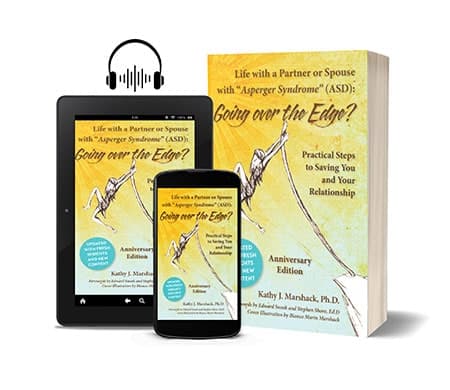
You can explore this concept through my books and in my Thinkific course modules—it’s the key to understanding the emotional “why” behind your communication differences.
A Community Rooted in Love, Not Labels
Everything I’ve built—from the NeuroDivergent Relationships podcast to the Radiant Empathy framework—is about bringing people together in understanding, not dividing them by diagnosis.
You don’t have to face this alone. You have a community that understands the heartbreak, the humor, the complexity, and the beauty of NeuroDivergent love.
So, take a deep breath. Start where you are. Explore what calls to you first.
And remember—every step you take toward understanding yourself and your partner sends out ripples of Radiant Empathy that reach far beyond your own relationship.
Listen to this episode of the NeuroDivergent Relationships podcast here → https://asd-ntrelationships.com/exploring-neurodivergent-relationships-insights-and-resources/